Sunday, September 14, 2014

GRAIN STORAGE--CAN WE TAKE CARE OF ARTHIYA AND AUDITORS ?


GRAIN STORAGE--CAN WE TAKE CARE OF ARTHIYA AND AUDITORS ?

TEJINDER NARANG


Grain Storage—A  Systematic Failure??
Tejinder  Narang

Food security and food production are the buzzwords for all inclusive Indian growth, but there has been a major policy failure in past decade for augmenting grain storage space .
FCI and State Agencies have 37mt (million tons) of covered storage. Since they procure 50-55 mt grain annually, this space is grossly inadequate. These Government outfits have CAP (covered and plinth) and “plinth only” depots for 13 mt. They are  just“atmospheric dummy depots”. They cannot be regarded as “stores” by any stretch of imagination.  Safety/quality of grains even  in covered spaces is questionable as per  recent reports of wheat bags found filled with mud in Freozpur(Panjab) and liquor bottles located in Jaipur.  This is an indication of  deep  rot and malaise within the system itself.
Since 2000 onwards, Punjab was to add  capacity of 7.12 mt and Haryana another 3.88 mt. Only 0.8 mt of storage space has been built during last three years. An  irretrievable systematic failure indeed.


Losses from “harvest to household” are assessed at  10% under covered and more than  20% for open cap/plinth storage. Taking mid way--  15%  damages on 50 mt grains @ Rs 15000/meteric ton, amounts to disappearance of 7.5mt of stocks. It would cost Rs 10500 crores annually, though actual reported loss by FCI is around 0.6% (Rs 450 crores). 

SILOS

What is preventing acceleration in creation of extra warehousing?  An ultra modern pilot  silo project for six  lakhs tons has already been implemented in 2005-07 by FCI and Adani Logistics. Why this model that has BOO (build own operate) concept with assured revenue of 20 years not seen rapid expansion? The possible reason  is--  because of  limitation of active inter connectivity of  mandis with silos  and provision of rail linkages.
Vertical silos are less capital intensive due to lower land coverage, clean, safe, and economical in long term as compared to conventional horizontal warehouses, provided post harvest operations are consistent for bulk handling. The delay in creation of silo storage space cannot be attributed to funding or  some commercial bottlenecks.  It is the mandi (market yards) system that needs to be reoriented specially for wheat. Mandis have to move near silos for bulk handling, cleaning and storage or silos have to be available within 2-3 km radius of mandis.  All this requires comprehensive coordinated planning, as rail linkages are also to be provided for dispatches.
There  are around 1700 mandis in Panjab that currently handle wheat in bagged packing. The  present mode is  -- Bagging  and debagging in 50/100kg packing for storage, subsequent loose movement to destination and final packing in bags. That route has to change to  bulk/loose handling, cleaning, gradation, storage, dispatches via railways. Clusters of mandis may have to be dedicated to a specific yard of silos for bulk/loose grains.

ARTHIYAS

Arthiyas (commission agents) are the prime players in mandi system. Reduction in mandis or clustering threreof for silos may rattle their  business of  bagging/ weighment/ quality manipulation (to some extent) as handling/cleaning will be mechanized.   There are about 45000 arthiyas in Punjab alone who are the intermediaries with procurement agencies for disbursement of payments to farmers (less commission). They are also financiers to the farmers. It is very difficult to dissuade farmers from system of traditional lending and repayment. Bank loans require procedures, collateral security and therefore are a deterrent to farmers.
An expert committee in Punjab listed several malpractices by commission agents: evasion of market fees and other taxes; over weighing of agricultural produce of  farmers; non payment of incidentals due to labor; deduction of excessive charges; illegal gratifications to the procurement agency and the marketing staff at the expense of farmers and illegal commissions. (World Bank report 2003)
Arthiyas have  controlled farmers, laborers and officialdom  for  last 50 years. Unless political will is demonstrated to break this nexus, silo systems may not be easily workable and viable as vested interests will continue to promote ideas of  conventional  godowning.

CONVENTIONAL STORAGES

Renting of  conventional horizontal warehousing system appears to be much cheaper when compared with cost benefits analysis of modern silos. Stacking of bags does not mean a good house keeping.  It makes efficacy of fumigation difficult and stocks are prone to high infestation and therefore natural destruction.
Other negative aspects are the leakages that filter in market or spraying water on grains for injecting “moisture tonnage” or replacing good bags with bad ones. These  practices  perpetuate concept of  “cheap rentals” . Wet wheat when  dried in the open and re-stored and distributed  develops toxicity as per  scientists of Karnal Research Institute.  Rentals when clubbed with such invisible losses make traditional storages very expensive for the owners. It is, however, highly profitable for all  intermediaries  thriving on institutionalized pilferage.

AUDIT  IMPLICATIONS

On audit books modern silo system will be faulted as it cannot capture  harsh reality of these well programmed frauds that make a mockery of rate of return on investments. Actual users/ millers get hooked on to the lower prices of pilfered stocks, while paper stocks in the Government books remain unchanged. The mind set of auditors has to change as these enormous losses  cannot be easily quantified.
Since new investments are being planned on BOO basis, a reasonable rate of return beyond currently offered term of seven years has to be guaranteed for PPP (public, private partnership).    Land  prices in Panjab/ Haryana and elsewhere are soaring and availability of cheap labor is getting limited. There are better alternatives like real estate for higher returns, than to  rely upon uncertain returns after seven years, when life cycle of a godown is 30 years.  Entrepreneurs are shying away from doing business with FCI/state agencies.
Unless these vital issues are addressed soon,  destruction  of grains may be much faster than its creation. Higher productivity/yields of crops may prove to be futile in real terms.
Tejinder Narang is a former Director of PEC Ltd. and now a freelance commodity analyst.

Wednesday, September 3, 2014

WHAT COURSE MUST INDIA'S RICE IMPORT TAKE?


WHAT COURSE MUST INDIA'S RICE IMPORT TAKE?

 FINANCIAL EXPRESS 03.09.2014

CLICK LINK

http://goo.gl/nvQv35


RICE IMPORT FOR TRIPURA -MIZORAM A CHALLENGING TASK.
  An opportunity of $450 million for foreign rice bidders.
For the first time FCI is compelled to import rice for North Eastern states of Tripura and Mizoram owing to temporary interruption in railway lines rather than lack of availability of rice. Monthly consumption of these two states is about 40-50000mt per month or half a million ton per annum.
Railways are commencing gauge conversion of 220km track from Assam to Agartala (Tripura) from 1st October 2014 while highways are also in shoddy state.   Imports for next two years—about one million tons-- through alternative route is a necessity rather than an option. Also due to absence of trucking worthy cross border routes, import may have to be diverted through Chittagong port (Bangladesh).
Present cost of procuring Indian rice is Rs 2755/qtl and despatch expenses are Rs 3200/qtl  to Tripura from North or south of India. It totals Rs 59550/mt or  about $975/mt as against $ 375-385/mt landed value of 25% broken Myanmar rice if supplied through Yangon port to Chittagong.  After accounting for unloading at Chittagong, transit storage, shortage, demurrage, road transport of 200km to Agartala (Tripura), financing charges etc. it should not cost more than $450 -$460/mt delivered at FCI depot in Agartala. Half a million import will be approximated at about $225 million (Rs 1370crore) per year vs Rs 2977 crores under local arrangements.  Apparent cost saving is 55%. But it is going to be logistical and procedural nightmare to handle this import.
FCI is attempting to engage three PSUs (PEC/MMTC/STC) for this import while they are not well versed for the scope of work involved.  Normally these PSUs finalise bids, contracting and shipments to Indian shores, hand over grains to FCI and transfer payments to foreign suppliers.  But in this case Indian PSUs may not be able to deal effectively with customs/phyto-authorities of Chittagong, handling agents and transporters of Bangladesh, who can be very tricky and manipulative. Port authorities in Chittagong can delay berthing/discharging vessels for India bound cargo due to their own local priorities.  Trucks can be in short supply as 25000 mt parcel requires 2500 trucks (about 10 mt per truck). Agreements by rice handling agents or transporters may be breached.  Pilferages may be attempted both during transit storages and road transportation. Even Government of Bangladesh’s (GOB) own wheat import have 2%-3% short-landing as routine occurrence, for which they deduct payments of shippers. 

There is no Government company in Myanmar who can transact 0.5 to 1 million tons of rice; private players of Myanmar lack export financing and are happy doing container business. Myanmar annual rice export is around 850,000 tonnes. China is currently major importer of their rice. If India chips in with its annual demand of 500,000 tonnes, rice prices can witness steep rise. FCI may therefore include other origins like Vietnam, Thailand, and Cambodia for evaluation of bidding and provide an option to supply these origins if commercial feasibility from Myanmar is eroded.       
International rice traders who can participate in this import are based in Singapore or Dubai or Bangkok. But will they be ready to undertake comprehensive operation for shipping the rice from Myanmar or elsewhere, clearance at Chittagong and then arranging despatches to Tripura at “fixed cost” to FCI/PSUs?  That alternative must also be explored.
 
There are three options for the Government--- First,-Import through PSUs if they are prepared to perform totality of operation themselves by disbursing actual expenses incurred by them;  Second let PSU configure the bidding process where the foreign suppliers takes the full obligation at a “fixed price” for origination at Mynamar or elsewhere for delivery at Agartala, build in their risk premium for Bangladesh and PSUs disburse the amount to them in two stages as suggested in the chart; Third, FCI issues a global tender in which PSUs and other foreign sellers bid and compete for delivery at Tripura from any origin and any route at a fixed price. The assurance of Bangladesh giving transit facilities to Indian Government must form integral part of the tender document.  The second alternative may be more practical.
The combined business of about two years is about $450 million apprx and its extension to third year cannot be ruled out. The quantum and pace of import tendering depends upon urgency at Tripura and commercial considerations. Will overseas rice traders bite the bullet??


Saturday, August 30, 2014

THE WHY OF LIFE--ECONOMIC TIMES 30.08.2014


THE WHY OF LIFE


 WHY OF LIFE ?
Tejinder Narang
When God decided to experience Life, He fractionalised Himself into souls; clothed them with mind and bodies and created multiplicity of active identities for mutual interaction. Finally, He disrobed them and made them fade into dormancy of oblivion of Oneness.
In intervening period, Man- the pinnacle of Lord’s creative expertise amongst all species-- and his life are riddled with unsavoury contradictions. He is chained in thoughts, resultant actions and circumstances which are not his making. Fear of loss happiness leads to unhappiness; wealth and power come with anxiety, envy and sleepless nights. Body continues to wither till it vanishes. All academic and professional acquisitions are buried in grave.  
Advice to man is--forgive all who hurt him, seek forgiveness for his egotism/ arrogance and be grateful to God for his cosmic creation. Right and wrong, he realizes, are relative states of mind. Truth remains elusive.
With powerful pull of physical world, man’s conviction in spiritual contemplation and   Divinity remains flippant.   Doubting Thomas he remains. As life burdens him, he accepts Divine Will with inner remorse and reluctance. Intellectually he knows there is no other way.

The greatest mystical paradox of life is to get out of trans- migratory cycle of bodies to know Life. Sufi Bulle Shah says Lord tricked souls to experience life; gifted them mind of five perversions, karmas, pain of His separation, and fear of death and promised that He will personally redeem them. Whenever Lord appears in human form as “Son of the Father” for redemption, He largely goes unrecognised, misunderstood and misconstrued by masses. Man thus remains tied to cycle of transmigration.

Why of Life is akin to experiencing feel of water in a mirage of a desert!!   

Tuesday, August 26, 2014

LOWERING LEVY HELPS RICE EXPORTS--FINANCIAL EXPRESS 26TH AUGUST 2014


CLICK LINK BELOW


http://epaper.financialexpress.com/c/3375749


ORYZA REPORT AUTHORED BY ME.


WITH “LEVY RICE” REDUCED TO 25%-- GOVT SAVES Rs 24000 CRORES PER ANNUM
================================================
ABOUT 10 MILLION TONS OF EXTRA MARKET AVAILABLITY WILL SOFTEN RICE PRICES; INCENTIVIZE EXPORTS.
Food Ministry has recently directed major paddy growing states of non –basmati rice to limit “levy” to maximum of 25% from earlier notified percentage of 30%-75%. In nut-shell, quantum of rice procured on Government account will be restricted.  This indeed is a very progressive step for surplus availability of rice in the market and consistent with WTO obligations of lowering public stock holdings and reduction in food subsidies. Though Government may be taking hard position at WTO, it appears to work for WTO compliance.
This levy reduction order will make open market rice cheaper; food inflation will be moderated; quality improvisation will take place; exports prices will be lower and non- basmati rice export will be incentivized.  Pressure on FCI and state governments for creating storage space will lessen.
In Kharif marketing season (KMS) commencing 1st October 2014 and till 21.07.2014, FCI procured 31 million tons of rice (fig 1)  in two different modes; 11 million tons is sourced from Panjab/ Haryana as custom milled rice (CMR); balance 20 million tons is purchased as “levy rice” from other states.   Under CMR, paddy is procured by FCI/state government agencies from farmers at MSP and thereafter processed into rice by FCI making payment of tolling charges to millers. Under levy rice system, farmers sell paddy to millers at MSP, and then millers sell a fixed percentage (now directed at 25%) as levy to states as per predetermined prices of rice.
FIG 1
Less procurement of 10 million tons
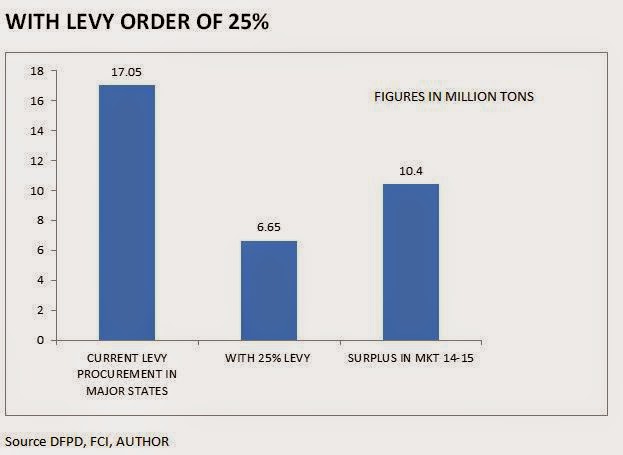
This existing system (CMR+ 30%-75%levy) has led to over procurement, overstocking, wastage/deterioration, excessive involvement of central funds, higher subsidies.  Reduction in levy to 25% will correct the systemic deficiencies.   Fig 2 ,  shows “excess” availability of about 10 million tons in the market when 25% levy orders are enforced.   One can surmise that Food Ministry is now targeting at a procurement of about 21-22 million tons in 2014-15, from 31 million tons in 2013-14. At acquisition cost Rs 24000/metric ton (FCI website)—procurement of 31 million tons amounts to whopping of Rs 74400 crores. The corresponding savings by reduced procurement of 10million tons will be Rs. 24000 crores.
FIG 2
Concerns of small millers
Since Chhattisgarh, AP, Orissa and Telengana are the most affected regions, small rice millers in these states may protest against such directions because they are denied assured purchases by the states. Small units will now have to undertake marketing directly for whatever quality they process or sell through exporters or undertake export directly. Millers with outdated processing technology may have to modernise for meeting market expectations/specifications.  As the intention is to eventually abolish the levy system, Centre may have to get over the resistance exerted by these stakeholders.
 Another argument that farmers will be denied MSP if they deal with private millers, carries little merit. India produces about 160 mill tons of paddy (eq to 106mill tons of rice), while only 47 million tons of paddy (eq. to 31 milled rice) is handled by FCI/government agencies. The fact being (160-47) =113 million tons of paddy is bargained directly by farmers. Thus debate on this issue is not maintainable.  Should in any year there is widespread procurement of paddy below MSP, Centre can authorise an ad-hoc intervention to stabilise the price to MSP as is done in the case of maize.
Exports eased
India’s 40% of non-basmati rice (about 2.5 million tons) is shipped out of Andhra Pradesh’s (AP) port of Kakinada. AP requires evidence of servicing  levy (currently 75%) of “release certificates” (RC) from their Civil Supplies Corporation before authorising export shipments.  In June-July2014, exporters of Non-Basmati rice could not obtain such “Release Certificate” as AP government was not willing to accept compliance of levy obligations done by millers in the newly created state of Telengana. This resulted into loss/ loss of profit owing to purchasing expensive rice from Chhattisgarh and payment of demurrage on the vessels. Buyers either deferred future business or diverted to Thailand. By mitigation of levy to 25%, such instances may be rare.
Threat of Thailand or Vietnam lowering their quotes of non- basmati rice and affecting Indian exports too gets minimized. Indian rice prices may soon be seen in bearish mode because the sentiment of extra supplies in the near future will prevail in the market.
FIG 3—COMPILATION DATA OF FIG 2


PERCENTAGE OF LEVY RICE TO BE DELIVERED IN STATES/UTs UNDER LEVY ORDERS DURING KMS 2011-12.


Sl.
No.
Name of the State/UTs

Category

Quantum of Levy
1.
2.
3.
4.
1.
ANDHRA PRADESH
MILLERS/DEALERS
75%
2.
ASSAM
MILLERS
50%
3.
BIHAR
MILLERS/DEALERS
50%.
4.
CHHATISGARH
MILLERS/DEALERS
50%
5.
DELHI
MILLERS/DEALERS
75%
6.
GUJARAT
MILLERS
50%                                           
7.
HARYANA
MILLERS/DEALERS
75%
8.
HIMACHAL PRADESH
MILLERS/DEALERS
50%
9.
JAMMU & KASHMIR
MILLERS/DEALERS
50%
10.
JHARKHAND
MILLERS/DEALERS
50%
11.
KARNATAKA
MILLERS/DEALERS
33.33%
12.
MADHYA PRADESH
MILLERS/DEALERS
30%                    
13.
MAHARASHTRA
MILLERS/DEALERS
30%
14.
NAGALAND
MILLERS/DEALERS
50%                                        
15.
ORISSA
MILLERS
75%
16
PUNJAB
MILLERS/DEALERS
75%
17.
RAJASTHAN
MILLERS/DEALERS
50%
18.
TAMIL NADU
MILLERS/DEALERS
30%
19.
UTTAR PRADESH
MILLERS/DEALERS
60%
20.
UTTARAKHAND
MILLERS/DEALERS
75%
21.
WEST BENGAL
MILLERS/Wholesalers
50%
22.
CHANDIGARH
MILLERS/DEALERSMMM
75%
23
PUDUCHERRY
MILLERS/DEALERS
50%


*******

 PERCENTAGE OF LEVY RICE TO BE DELIVERED IN STATES/UTs UNDER LEVY ORDERS DURING KMS 2012-13.


Sl.
No.
Name of the State/UTs

Category

Quantum of Levy
1.
2.
3.
4.
1.
ANDHRA PRADESH
MILLERS/DEALERS
75%
2.
ASSAM
MILLERS
50%
3.
BIHAR
MILLERS/DEALERS
50%.
4.
CHHATISGARH
MILLERS/DEALERS
50%
5.
DELHI
MILLERS/DEALERS
75%
6.
GUJARAT
MILLERS
50%                                           
7.
HARYANA
MILLERS/DEALERS
75%
8.
HIMACHAL PRADESH
MILLERS/DEALERS
50%
9.
JAMMU & KASHMIR
MILLERS/DEALERS
50%
10.
JHARKHAND
MILLERS/DEALERS
50%
11.
KARNATAKA
MILLERS/DEALERS
33.33%
12.
MADHYA PRADESH
MILLERS/DEALERS
30%                    
13.
MAHARASHTRA
MILLERS/DEALERS
30%
14.
NAGALAND
MILLERS/DEALERS
50%                                        
15.
ORISSA
MILLERS
75%
16
PUNJAB
MILLERS/DEALERS
75%
17.
RAJASTHAN
MILLERS/DEALERS
50%
18.
TAMIL NADU
MILLERS/DEALERS
30%
19.
UTTAR PRADESH
MILLERS/DEALERS
60%
20.
UTTARAKHAND
MILLERS/DEALERS
75%
21.
WEST BENGAL
MILLERS/Wholesalers
50%
22.
CHANDIGARH
MILLERS/DEALERSMMM
75%
23
PUDUCHERRY
MILLERS/DEALERS
50%


*******